

Price: $1,199.99
(as of Feb 26, 2026 19:17:35 UTC – Details)

Ready to take your drumming into the digital age? The Donner BackBeat is here to deliver just that. With its glowing silicone drum pads, massive library of sounds, sleek iOS/Android control, hidden cabling, and touch display it’s obvious this is an instrument built for both bedroom jamming and stage performances. But how does it perform in practice? Before we get to the feel of the rubber and the sound of the speakers, let’s clear up the terminology. The main brain is called the BackBeat, BackBeat versus the BackBeat Module — and yes, there’s a difference.
The BackBeat is the entire drum system: pads, frame, control module, and software. The BackBeat Module is just the control brain itself, so if you’re talking features, the whole drumming experience is mostly in the Module.
It’s tempting to try and stick this kit in the same category as much simpler electronic sets, so we’ll end there. This is no starter kit with twenty sounds; this is more like a pro instrument dressed in gamer’s clothing.
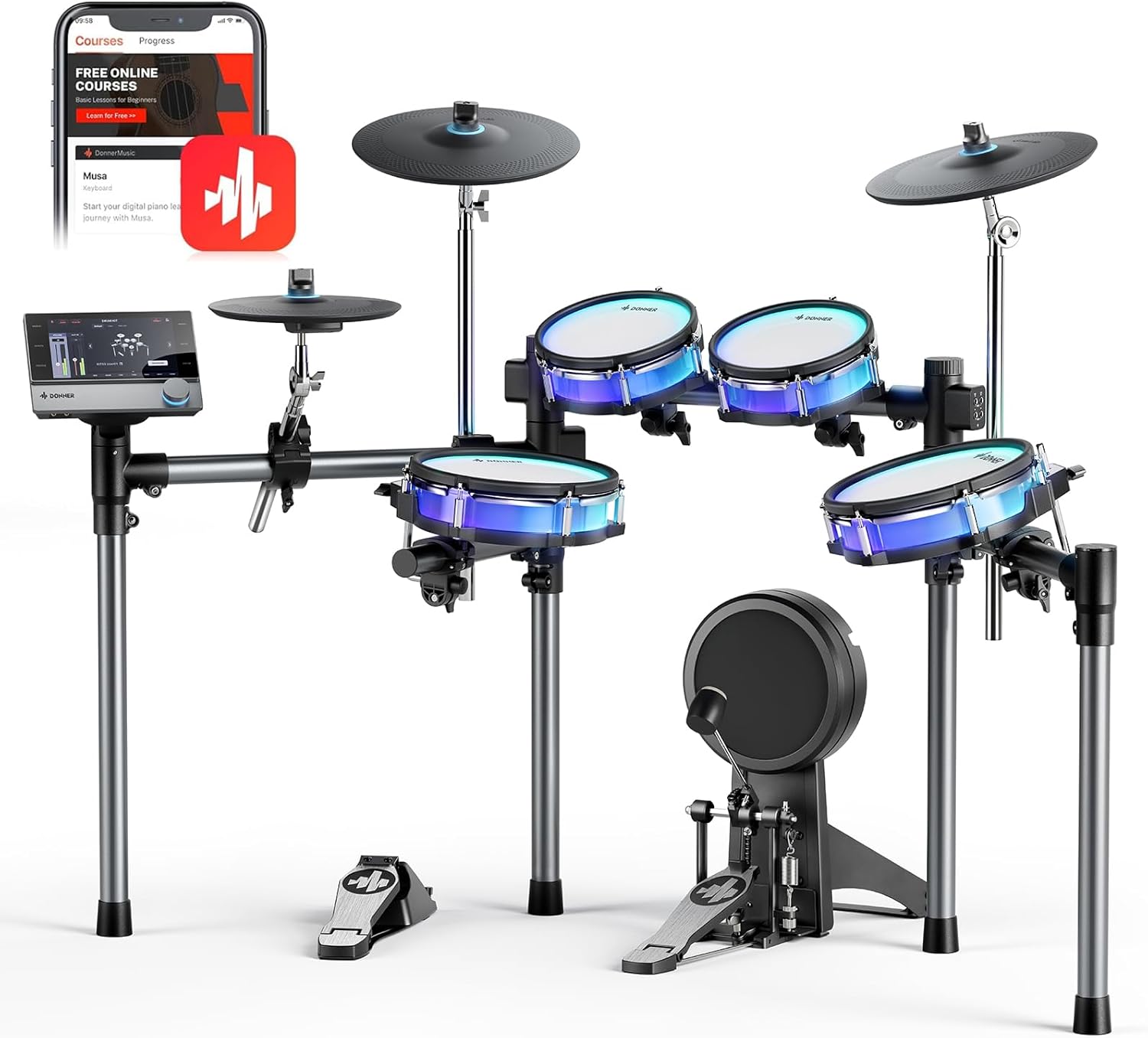
As soon you start assembling your electronic drum set, the first thing that’ll jump out at you is how much of a departure this is from the usual. Instead of snapping wires to pads and holding them in place with velcro, everything’s routed through the inside of the frame. That’s a clever idea — no visible wiring, no tangle, just clean and minimal. It’s the kind of detail you’d expect from drum modules five times the price.
In place of the traditional smaller pads are seven-inch, technicolor spaces where you play. They’re firm enough to feel responsive, soft enough not to kill high-volume rimshot dreams, and deep enough to avoid crosstalk. When you hit them, they light up… sometimes gloomy reds or purples, sometimes pulsating patterns that follow dynamics (the software-controlled lighting responds to how you hit). For practice indoors, silent pad noise is a blessing.
Hit the kick and it feels solid, even with a double pedal clamped onto it. The snare and cymbals are dual-zone, meaning you can hit the surface and the rim (or edge) separately. The ride cymbal, where you’d expect this to shine, also senses bell hits. Each pad lights up from beneath, not just for show, but as feedback for zones. It’s an elegant fix for visibility during practice.
Now for the elephant in the room — the touchscreen. Seven inches feels like overkill on a drum brain until you actually tap it and scroll modal windows to access parameters. There’s something distinctly futuristic about dialing in reverb, EQ, or tuning on a flat screen instead of twisting knobs. Menus flow okay, but it’s not laptop levels of slick — occasional stutters pop up, especially when switching fast between practice and performance.
Where the kit really launches itself past competitors is sound depth. 1126 sounds isn’t just a number for bragging; it’s a playable range straight out of classic rock, modern pop, hybrid acoustic kits, electronic kits, percussion instruments, and layered world sounds.
The VST-level processing inside the module gives you effects: compression, modulation, familiarity, muffling, tuning up or down, as well as three-band EQ. You can truly sculpt dozens of kits into something uniquely yours. Want to drop your snare into a cathedral? Add a gate to the hi-hat? Load a chilling reverberated drum fill from a fusion song into a rock anthem? It’s all there, and fast.
Bundled with the kit is access to the Donner app (iOS/Android): over 100 built-in practice songs, rhythm games, and a full play-along mode. Some users report lag on older phones, but most experience smooth play. Games are a small twist on standard metronome tools — an unexpected, motivating layer when grinding scales starts to feel stale. That said, the sound library could shrink in terms of ultra-modern electronic genres — for metal guitarists, future bass producers, or extreme genre purists, you may need to import kits.
There are a few omissions to flag. There’s no dedicated hi-hat stand or kick pedal in the package. You’ll need to source those if you don’t already own them. Likewise, a drum key isn’t included, but the tension rods are easy enough to tweak by hand. These are small gripes, but they do impact out-of-the-box readiness.
The frame is solid aluminum and clamps everything solidly. It doesn’t wobble under hard playing, and I was able to set it up in under forty minutes thanks to the built-wiring scheme. The trade-off is that it’s a larger footprint, so closet storage isn’t an option unless you’re okay popping the pads on and off each time. Several users posted on forums saying their kid siblings now kick around a shiny drum set in the living room — basically an unintended rave machine.
At the end of all these glowing pads, 1100+ sounds, and touchscreen menus, you might ask: is it fun to play? Yes. The touch sensitivity is great — ghosting on the toms, consistent swells on the ride, fast triggering on the bass — but there’s just enough give to keep it forgiving for beginners.
Ultimately, unless you’re after pristine studio recording right out of the box, this is much more than a practice tool; it’s a playable instrument. The balance between customizability, modern features, and visual flair makes it stand out as something genuinely unique. The quiet pads are a huge plus for home use, and the hidden-wiring design is a smart touch.
So if you’re a drumming hobbyist who loves gadgets, want to create custom kits, and don’t mind downloading your own pedal setups, the BackBeat is a compelling choice. Its flexibility makes it equally suited to the bedroom rocker, the space-conscious gigging drummer, and even to parents trying to gently introduce a kid to the joy of rhythm.
If you hit “buy” expecting a simple plug-and-play kit, you’ll be in for an extra hour of menu diving. But if you’re after a uniquely customizable, lights-and-sounds powerhouse with a futuristic touch screen vibe and are willing to fiddle a bit at first, you just might find a partner for your next year of practice.
Quality: Sleek. Innovative. A little menu-heavy out of the box. But responsive, inspiring, and standout— that’s the Donner BackBeat.
